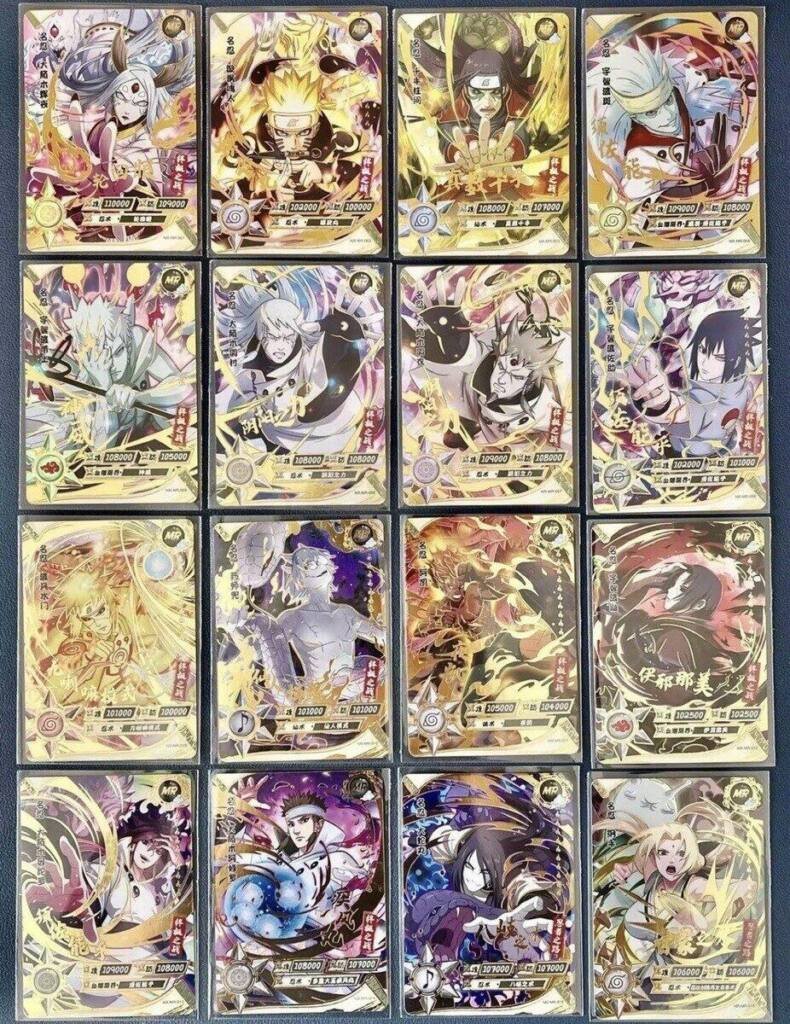
Are Naruto Cards Worth Anything? A Collector’s Guide to Real Market Values
Most Naruto cards are worth somewhere between nothing and about two dollars. If you’re holding a shoebox of them hoping for a retirement fund, the honest answer is probably not this time.
But value is concentrated in a small number of cards, and it comes down to four things stacking up at once: which family of card it is, its rarity, its condition, and whether anyone’s actually buying that character right now. Here’s how to tell which pile yours is in.
Which family of card do you have?
There are three main groups of Naruto cards floating around, and they are not worth anywhere near the same amount.
| Card family | When and where | What it is typically worth |
|---|---|---|
| Kayou | Made in China since 2019. Almost certainly what you are holding if you got cards recently, from a gacha shop, a friend, or a mystery box. | Kayou holds the license and prints in enormous volume. The flashy top-tier cards can sell for real money inside China’s collector market, but an ordinary pull from a pack is worth cents. |
| Bandai Naruto Collectible Card Game | Sold in the US and Europe roughly from 2006 to 2011, and out of print for well over a decade. | First edition holo rares of headline characters like Naruto, Sasuke, and Itachi are the ones most likely to surprise you. Sealed unopened boxes tend to do better than loose singles, since supply of unopened product only ever goes down. |
| Everything else | Panini and Topps sticker sets, carddass cards from Japan, vending machine prize cards, and unlicensed knockoffs. | Almost all of it is worth nothing beyond what it means to you personally. |
The trap that makes most “value” articles wrong
Here’s the thing almost nobody explains properly: the rarity tier printed on a card is not the same as scarcity in the real world.
A Kayou card marked UR is rare inside a box, because only a few show up per case. It is not rare in the world, because tens of millions of boxes have been printed and sold. A lot of value charts online just look at the tier ladder, assume higher letters mean higher money, and end up wildly wrong, sometimes off by a factor of fifty.
Rarity tier tells you how hard a card was to pull. It does not tell you how many other people also pulled one, and that second number is the one that actually sets the price.
What makes a card worth money
Four things generally need to stack together for a card to be worth real money.
- Character, which matters most. Naruto, Sasuke, Itachi, and Kakashi consistently pull the highest demand. A card of a minor background character in the exact same rarity tier is worth a fraction as much, sometimes ten times less, because collector demand tracks the character, not the printed letters.
- Condition, which matters just as much. A bent corner or a visible scuff can cut a card’s price in half or more. Mint condition is close to the whole game in this hobby.
- Grading, which changes the math further. A professionally graded card from a service like PSA or BGS in a high grade sells for meaningfully more than the same card raw. It only makes financial sense if the card is already worth several times the grading fee, otherwise you are spending more to prove the value than the value itself.
- Demand, which comes and goes. A character trending because of a new anime season or a viral clip can spike a card’s price for a few weeks. That is not a permanent value, it is a moment, and prices tend to settle back down once the spike passes.
How to check what yours is worth
This takes about two minutes per card, and it’s worth doing properly rather than guessing.
Search the card’s exact name plus its set name on eBay, then filter to sold listings only, not active ones. This is the single most important step. Active “asking price” listings are fantasy, since sellers can type any number they want. Sold listings are what people paid.
Once you’ve got sold listings, ignore the single highest sale. Look at the middle of the last ten sales instead of the outlier. That middle number is a much more honest picture of what your card would fetch on a normal day.
Keep raw and graded cards separate in your search. They’re different products with different prices, and comparing them will give you a number that doesn’t apply to what you own.
Spotting a fake
If you’re buying rather than checking your own collection, a few signs are worth watching for: printing that looks fuzzy or slightly pixelated, especially in small text, colors that look a shade off from official product photos, card stock that feels thinner or flimsier than it should, foil that’s missing, patchy, or misaligned with the print underneath, QR codes or authenticity marks that don’t scan or don’t match, and a “sealed” box priced well below what everyone else is charging for the same thing.
The safest check is to pull up the manufacturer’s own official product photos and compare them side by side with what you’re looking at. Counterfeiters can fake a lot of details, but matching every detail across a full photo comparison is much harder than faking one.
What to do with a pile of low-value cards
If you’ve gone through this and most of what you have is worth pennies, you’re not alone. That’s true for the overwhelming majority of collections, including plenty owned by people who’ve been collecting for years.
A few honest options: bundle common cards into cheap lots for other collectors starting out, keep the ones you like for display, or set aside anything that checks the boxes above (recognizable character, high printed rarity, good condition) and get a second opinion before assuming it’s worthless.
The rare surprise does happen. It’s just rarer than the packaging wants you to think.
If the cards you are holding are the modern Chinese ones, the full Kayou guide covers how their rarity ladders and product lines actually work. For figures rather than cards, the same valuation logic is laid out in the Funko Pop guide.
Common questions
What is the rarest Naruto card?
There is no single answer, because rarity works differently in each card family. Within Kayou’s Chinese sets the chase tiers sit at the top of each individual wave, so the rarest card depends entirely on which wave you are asking about. Within the out-of-print Bandai Western game, first edition holo rares of Naruto, Sasuke, and Itachi are the ones most likely to carry real money.
Are older Bandai cards worth more than Kayou cards?
Usually, but not always. Bandai’s game has been out of print for well over a decade, so supply only shrinks, which supports prices on first edition holos and sealed product. Kayou is still in active production at enormous scale, so an ordinary pull is worth cents. A top-tier Kayou chase card of a headline character can still beat a mid-tier Bandai card.
Is it worth getting my Naruto cards graded?
Only if the raw card is already worth several times the grading fee. Grading costs the same whether the card is worth two dollars or two hundred, so submitting low-value cards loses money even when they come back in high grades. Check sold listings for the raw card first, then decide.
Where should I sell Naruto cards?
eBay is the practical default, because its completed-listings data is also how you price the card in the first place. Bundle commons into cheap lots rather than listing them individually, since the postage and time cost more than the cards. For anything genuinely valuable, a graded card in a dedicated collector marketplace will usually reach a more serious buyer.


