Top 10 Best Anime Fight Scenes of All Time
A great anime fight isn’t just impressive animation. The best ones are moments where a character’s entire arc, a studio’s entire budget, and a series’ entire thesis all collide at once, and the fight becomes the argument the show has been building toward the whole time.
This list ranks the ten that pull that off most completely, weighing animation, stakes, and what the fight actually means to the story around it, not spectacle alone.
10. All Might vs. All For One (My Hero Academia)
All Might’s final fight as the world’s Symbol of Peace is built entirely around a ticking clock. He’s already burned through most of the power keeping One For All’s true toll at bay, and the fight is staged less like an even contest and more like a countdown to the moment his body simply can’t take any more.
What makes it land isn’t the raw power on display, considerable as it is, but the framing around it: the entire story has spent chapters establishing exactly what winning will cost him, so every exchange lands with the specific dread of watching someone spend the very last of something irreplaceable to protect people who don’t fully understand what they’re witnessing.
The fight also works as a passing-of-the-torch moment structurally, even though it isn’t framed that way explicitly in the sequence itself. Midoriya watches his mentor fight at what both of them know is the very edge of what his body can survive, and that image, rather than any specific line of dialogue, is what actually communicates the weight of what One For All is going to cost the next person who carries it.
9. Naruto vs. Pain (Naruto Shippuden)
Naruto’s fight against Pain during the Akatsuki‘s invasion of Konoha is less a single fight than an entire arc’s worth of escalation compressed into a handful of episodes, and it’s the moment the series fully commits to Naruto as a genuine, world-shaping force rather than an underdog still proving himself.
The fight matters as much for what happens after the fighting as during it: Nagato’s Rinne Rebirth, reviving everyone he’d killed in the attack, and the conversation between Naruto and Nagato that follows is the clearest, most direct statement of the entire series’ core theme, that reaching someone matters more than defeating them. Few fights in the genre pair spectacle with thematic payoff this cleanly.
It also stands out for the sheer scale of destruction the animation is willing to show and then reckon with. Konoha isn’t just threatened in the abstract, it’s leveled on screen, and the following episodes spend real time on the aftermath rather than resetting the village back to normal by the next arc. That willingness to let a fight’s consequences stick around is part of why this sequence still gets cited as a high point of the franchise nearly two decades after it first aired.
8. Spike Spiegel vs. the Red Dragon Syndicate (Cowboy Bebop)
Cowboy Bebop’s finale isn’t built around raw power the way most entries on this list are. It’s a slow, deliberate push through the Red Dragon Syndicate’s ranks toward a final confrontation with Vicious, staged with the show’s signature jazz-scored restraint rather than escalating power levels.
What makes it one of the best fights in the medium is tone rather than scale: every frame is doing double duty as action and as character study, closing out Spike’s arc with the same weary, unresolved energy that defined him for the entire series. It’s proof that a genre-defining fight doesn’t need transformations or energy blasts to earn its place on a list like this one.
7. Sung Jinwoo vs. Igris (Solo Leveling)
Jinwoo’s fight against the Blood-Red Commander Igris works as a turning point specifically because of where it lands in his arc. He’s mid-Job Change Quest, thrown into a fight well above what he’s supposedly capable of at that stage, and the animation studio treats the moment with a scale that signals to the audience this is the fight where the story stops being a normal power-fantasy climb and starts being something bigger.
The fight’s reputation rests heavily on how it’s staged, with fluid, high-budget animation that stood out even in a genre increasingly full of well-funded adaptations, and it’s frequently cited as the moment Solo Leveling’s anime adaptation proved it could match the source material’s biggest moments rather than undersell them.
For readers who came to the story through the original web novel or manhwa, the fight also carries the specific satisfaction of seeing a moment that already had a strong reputation on the page get matched, rather than diminished, by its anime adaptation, which isn’t a given for source material this action-heavy and this frequently adapted across different mediums.
6. Frieren vs. Aura (Frieren: Beyond Journey’s End)
Frieren is a show built almost entirely around quiet, contemplative pacing, which makes its rare full-scale fights land with outsized weight when they finally arrive. The confrontation with Aura the Guillotine is the clearest example: centuries of accumulated grief, patience, and quietly devastating magical skill delivered in a single, controlled sequence.
What separates it from a more conventional shonen showdown is restraint. Frieren doesn’t need to shout to make a fight feel enormous, and the sequence is frequently cited specifically for how it uses the show’s established slow rhythm to make every spell exchanged feel like it’s carrying decades of backstory rather than just raw magical power.
Frieren’s own emotional distance, established across the entire series as a character who’s outlived nearly everyone she’s ever cared about, gets used here as a genuine tactical and thematic asset rather than just a personality quirk. Her patience in the fight mirrors her patience across her whole extremely long life, and the sequence rewards viewers who’ve been paying attention to that characterization rather than treating the fight as a standalone spectacle.
5. Jotaro Kujo vs. DIO (JoJo’s Bizarre Adventure: Stardust Crusaders)
The Stardust Crusaders finale is a genre landmark specifically because of how it handles time itself as a combat mechanic. DIO’s ability to stop time, and the desperate, escalating exchange of blows once Jotaro discovers he can match it, turned a fistfight between two Stand users into one of the most referenced action sequences in anime history.
Decades after it first aired, the fight’s central image, two silhouettes trading blows in frozen time, remains one of the medium’s most recognizable single moments, referenced and parodied across countless other series since. Few fights anywhere in anime have had that kind of lasting cultural footprint.
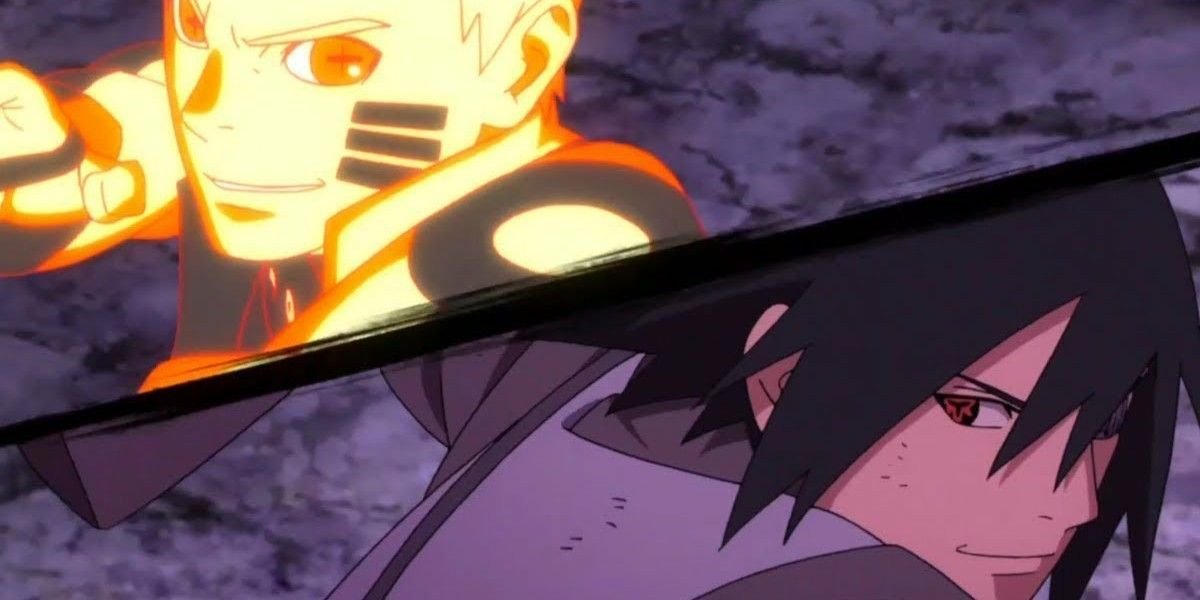
4. Naruto and Sasuke vs. Momoshiki (Boruto: Naruto the Movie)
This fight earns its spot for a specific reason: it’s the moment the Boruto era proves it can stage a fight at the same scale the original series built its own legacy on, with Naruto and Sasuke fighting alongside each other rather than against each other for the first time in years.
Momoshiki’s escalating threat, and the way the fight forces both Naruto and Sasuke to genuinely struggle rather than overpower a lesser villain, gave the sequel series real credibility with longtime fans skeptical that Boruto could deliver action on the level the original had built its reputation on.
There’s an additional layer worth naming: this is also the fight during which Sasuke loses his Rinnegan, a permanent, consequential cost that the sequel series carries forward rather than quietly walking back. Fights that leave lasting scars on their winners, not just their losers, tend to age better than ones where victory comes free, and this one is a clear example of that principle in action.
3. Goku and Vegeta vs. Broly (Dragon Ball Super: Broly)
Dragon Ball Super: Broly reworked one of the franchise’s most beloved non-canon villains into an official part of the story, and the resulting fight is relentless in a way even Dragon Ball’s own history of escalating power struggles rarely matches. Goku and Vegeta, fighting together rather than separately, are pushed to desperation by an opponent whose power seems to have no obvious ceiling.
The fight benefits enormously from the film’s animation budget, one of the highest the franchise has ever received, and it’s frequently cited as proof that Dragon Ball’s action, even decades into the franchise’s history, can still be pushed further when a studio commits fully to the spectacle.
Broly’s redesign for this film is part of why the fight lands as well as it does. Rather than the loud, screaming rage-monster version of the character from the older non-canon films, this Broly is reframed as a tragic figure manipulated by his own father, which gives Goku and Vegeta’s fight against him a moral complication most Dragon Ball villains don’t carry. Beating him doesn’t feel like defeating evil, it feels like stopping someone who was failed by everyone around him long before this fight ever started.
2. Saitama vs. Boros (One Punch Man)
One Punch Man’s entire premise is built around undercutting the genre’s usual escalating-power formula, since its main character can end almost any fight in a single hit. The Boros fight works specifically because it’s the rare opponent who forces Saitama to engage rather than end things instantly, and the animation studio matched that shift with some of the most fluid, high-impact fight choreography the medium has ever produced.
It’s a fight that manages to satirize shonen conventions and deliver a spectacular shonen fight at the same time, which is a difficult balance very few series have managed as successfully. Boros himself is written with just enough dignity and backstory that the fight doesn’t feel like a joke at his expense either, which keeps the sequence from undercutting its own stakes even while the show’s usual comedic tone stays intact around the edges of it.
1. Gojo vs. Sukuna (Jujutsu Kaisen)
The Shinjuku Showdown between Gojo and Sukuna is the most frequently cited pick across critics and fans alike, and it’s easy to see why. MAPPA committed an extraordinary level of animation budget and craft to the sequence, but what elevates it above pure spectacle is the philosophical weight behind the fight: two characters widely regarded as the strongest in their respective categories, each representing a different worldview about power and its consequences, finally colliding after the entire series built toward exactly this confrontation.
The fight’s reputation isn’t just about who wins. It’s about how completely the animation, the stakes, and the thematic argument of the whole series converge in one sequence, which is precisely the standard this entire list is built around.
Part of what makes it so widely cited even outside dedicated Jujutsu Kaisen fandom is timing: the sequence arrived at a moment when the series’ popularity, and MAPPA’s own reputation for high-effort action production, were both near their peak, which meant the fight got discussed and dissected across a much wider audience than a comparable moment might have reached in a smaller franchise. That combination of craft and cultural reach is part of why it sits at the very top of this list rather than being one strong entry among several.
Fights that almost made the list
A ranking like this one always leaves great sequences on the cutting room floor.
- Ichigo vs Aizen (Bleach) carries enormous emotional and narrative weight after hundreds of episodes of buildup, but the pacing around it divides fans in a way that kept it just outside the top ten here.
- Guts vs Nosferatu Zodd (Berserk) remains one of the medium’s most influential fight scenes for how it blends horror and action, though its reputation rests as much on the manga’s original panels as on any single anime adaptation.
- Luffy vs Katakuri (One Piece) is frequently cited by longtime fans as one of the series’ best pure duels, built almost entirely around Luffy learning to read and counter an opponent with an unfair predictive ability. Its length across dozens of episodes makes it a harder recommendation for viewers looking for a single, self-contained sequence.
Why some of the best fights aren’t the most powerful
To state it directly, what this list’s inclusion of Cowboy Bebop and Frieren is arguing for: raw power scaling isn’t what makes a fight great, even though it’s the easiest thing to rank fights by. Both of those entries feature characters operating at a fraction of the destructive output shown elsewhere on this list, and both still land as top-tier fights because everything the fight needs to say about its characters gets said within the fight itself, rather than requiring a bigger explosion to compensate for weaker character work.
That’s a useful lens for evaluating any fight scene, not just the ones on this specific list. A battle between two overwhelmingly powerful characters can still feel hollow if the story hasn’t earned the stakes beforehand, while a comparatively low-key confrontation between two well-established characters can carry more tension than a city-leveling battle between two strangers the audience has no reason to care about yet.
The three things this list weighed
No formula settles an argument like this, so it came down to three things.
- The animation itself. Sakuga quality, choreography, and how much the direction adds beyond the raw movement.
- What the fight costs. Real stakes for the characters involved, not just spectacle.
- What it pays off. How much of the story’s prior buildup the fight actually resolves.
A fight can be visually spectacular and still miss this list if it doesn’t carry real narrative weight. A few entries here, Cowboy Bebop and Frieren especially, prove that scale and power level aren’t requirements for a fight to earn a spot among the genre’s best.
Common questions
What is the best anime fight of all time?
Gojo versus Sukuna from Jujutsu Kaisen tops this list. MAPPA committed extraordinary animation resources to it, and the fight also resolves a philosophical clash the series had been building toward for its entire run.
What makes an anime fight actually good?
Three things working together: animation quality, real stakes for the characters involved, and payoff for what the story built beforehand. A visually spectacular fight with nothing riding on it rarely stays memorable.
Which Naruto fight is the best?
Naruto versus Pain during the invasion of Konoha ranks highest here. It compresses an arc’s worth of escalation into a few episodes and pays off the series’ central theme, since the resolution comes through conversation rather than a killing blow.
Does a great fight need a huge power level?
No, and two entries here prove it. Cowboy Bebop’s finale and Frieren versus Aura both operate at a fraction of the destructive output elsewhere on the list and still land, because the character work carries them.


